

Same-vertical CPM across the portfolio is also up 40% — this is auction-side, not creative-side. Holding is correct; budget actions won't fix it.
Set client expectation in the weekly report; this is the auction, not the ads.
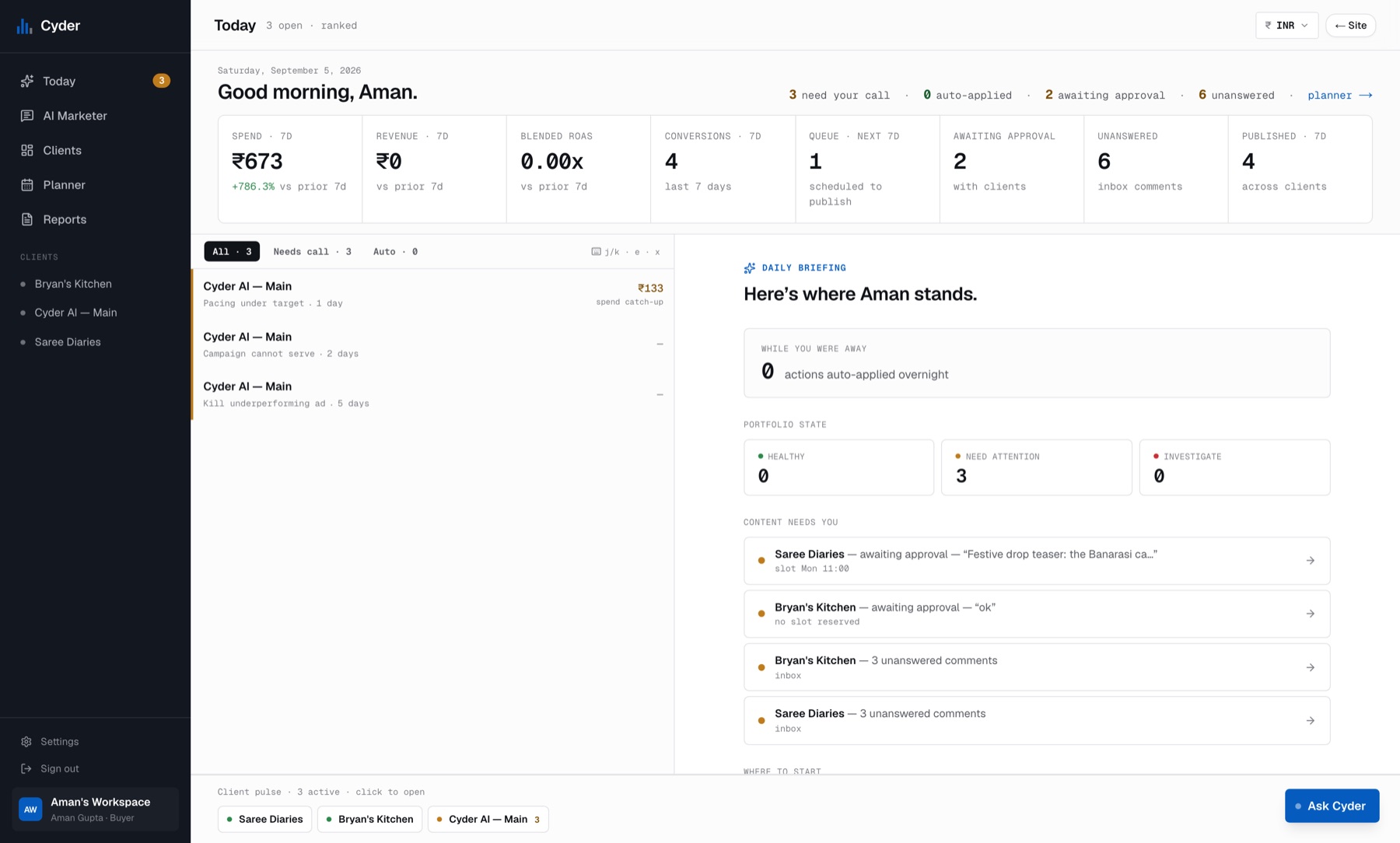
Something in your book is slipping right now — a human buyer caps at 6–8 clients. Cyder plans, launches, manages, and reports across all of them, with your approval before anything changes.
First 10 minutes: the free audit — every leak in your book with a ₹/month number on it. Disconnect anytime.
Proof: the ads promoting Cyder are planned, launched, and managed by Cyder — live on Meta & Google right now.
It holds what a human at 6+ clients can’t — every signal, every client, every day.
Talk strategy like you would with a senior buyer — it checks your tracking itself first.
Plain-language brief in; staged strategy out — platform split, budgets, creative briefs, every claim citing the account's own evidence. It checks your tracking live before it plans.
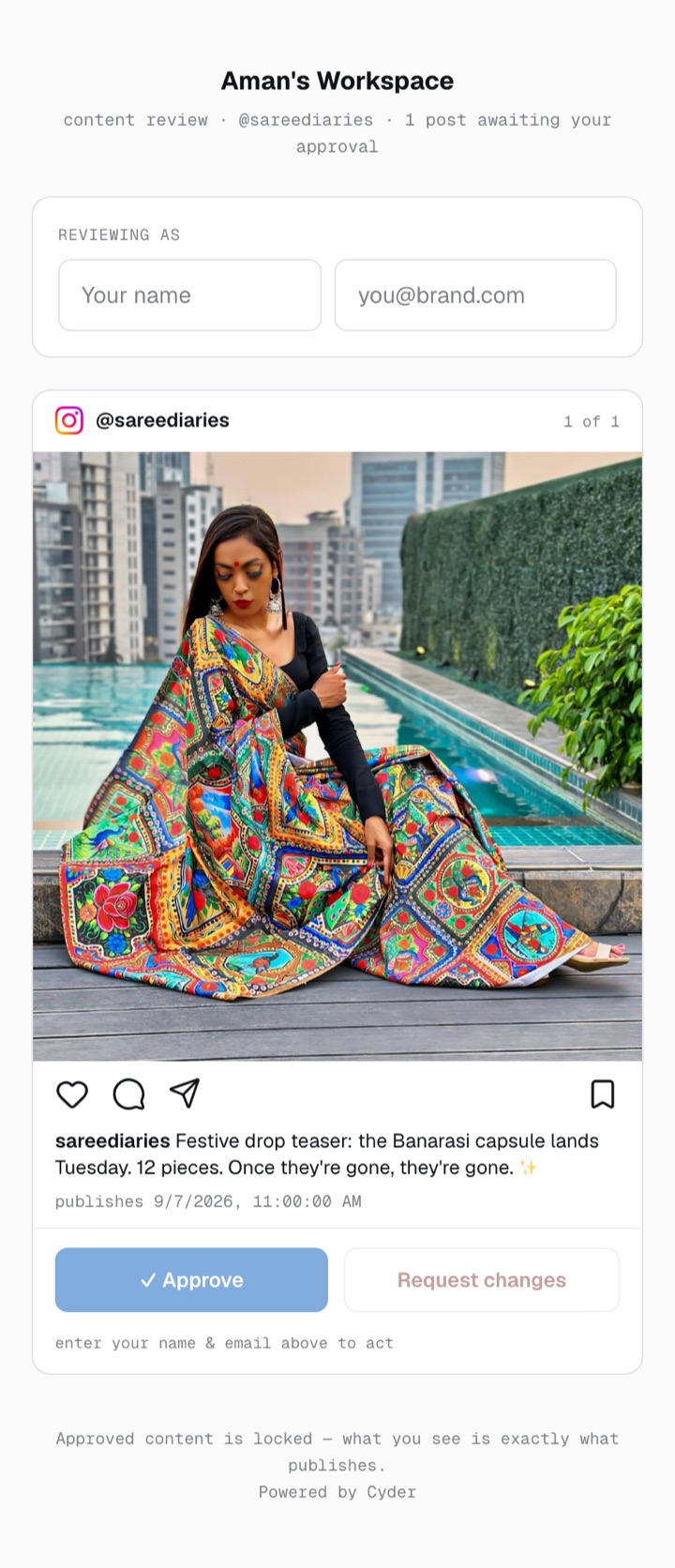
The strategy compiles into real campaigns — created paused, never spending without you.
The strategy compiles into real campaigns on Meta and Google — pre-launch checks run first, creatives graded before they spend. You review and flip live.
Evidence-cited calls daily. Approve one, and it executes on the ad platform.
Kills, scales, and pacing calls daily, evidence attached. Approve one and it executes — logged and reversible. Nothing auto-executes.
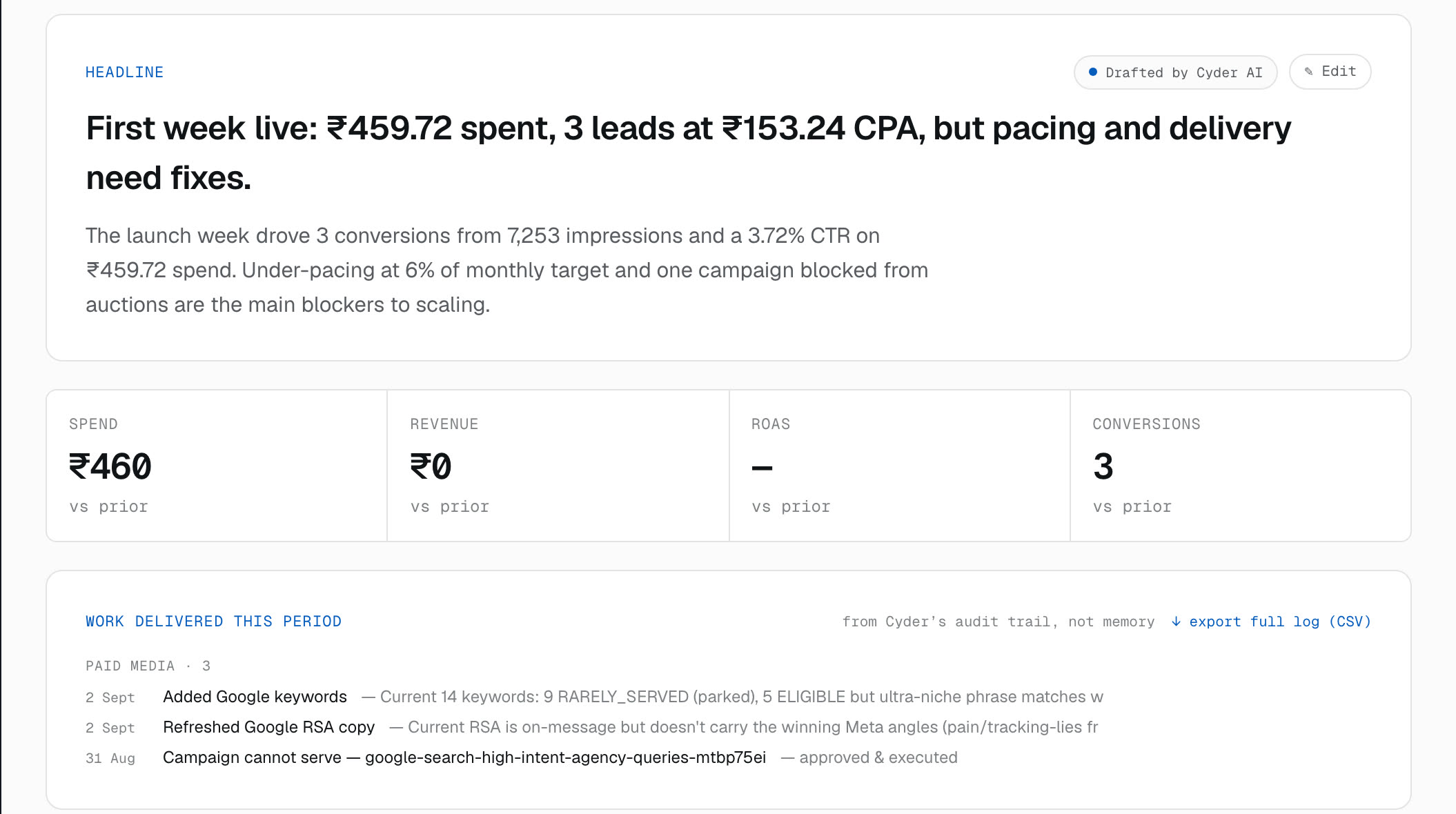
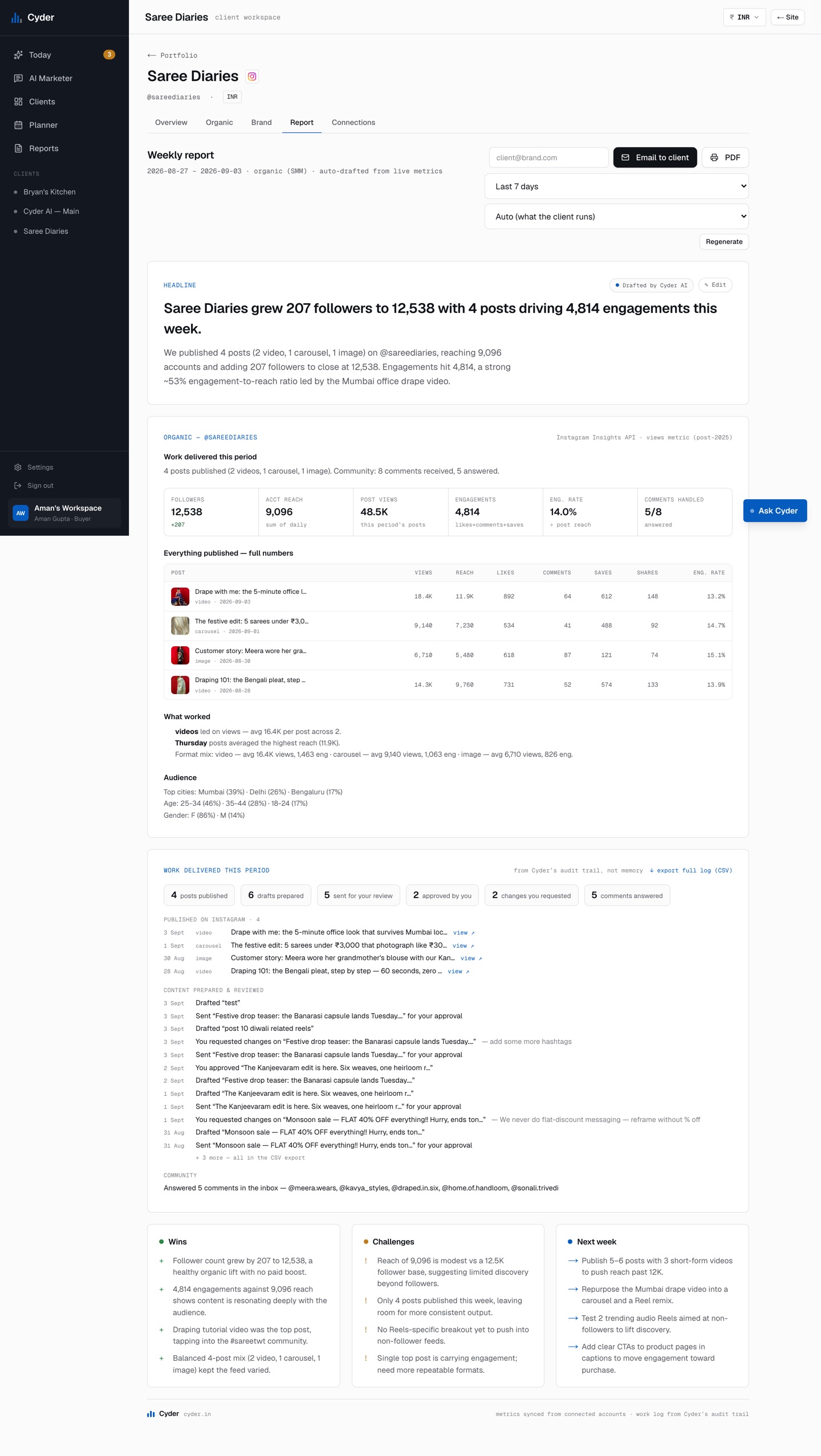
The weekly client report, written before you wake up.
Wins, watchouts, and next steps drafted before you wake — the why attached. One tap to send; Slack digest every morning.
No LLM guesswork in the audit path — every finding is deterministic math you can defend line-by-line when your client asks. Fourteen detectors across three families:
It reads the creative next to its numbers — every verdict must cite the metric behind it. No “Visual: 87%” black-box scores. A real analysis from the live demo book:

Generic flat-lay of 4 lipsticks with phone/plant props — no motion cue, face, or tension to stop the scroll.
Zero on-image text or claim; viewer can't tell if it's shade range, formula, or price without reading caption.
No overlay text present at all — 'Sold out in 48hrs' scarcity hook is wasted in the body copy, not on frame.
No visual CTA in-frame; relies solely on Meta's 'Learn More' button which underperforms 'Shop Now' for D2C.
The strongest evidence that Cyder is reasoning about your accounts — not just tripping thresholds.
Same-vertical CPM across the portfolio is also up 40% — this is auction-side, not creative-side. Holding is correct; budget actions won't fix it.
Set client expectation in the weekly report; this is the auction, not the ads.
Sustained 1.15x+ target ROAS over a meaningful sample (240 conversions, well above noise floor). Safe within the ±20% / 72h learning-phase limit.
Spend pattern matches the burn-ceiling rule. Other ads in the ad set are still in the running, so reach won't collapse from this pause.
Every output is shown alongside the data it was based on. You can see which rule fired, which math produced the number, and which model reasoned about it.
Week-over-week change decomposes into its drivers with no residual — and the fatiguing ad behind a CTR drop is named. Every point is defensible on a client call.
Every anomaly is checked against your other clients — vertical first, whole book second. Single-account tools structurally cannot write this sentence.
Verdict, confidence, and the nuance rules miss — anchored on MER where revenue is connected, because platform ROAS alone lies.
Each client gets its own 21-day distributions — anomalies are z-scores against the account’s own history, not generic thresholds. Plus the checklist a senior buyer runs before touching anything:
A creative theme winning in apparel might be the unlock for the beauty client across the hall. Cyder surfaces it.
Short video creatives leading with a strong hook in the first 1.5 seconds.
Outperforming portfolio average ROAS by 31% across DTC apparel and beauty. Untested in DTC home and supplements — both verticals where AOV is high enough for this pattern to plausibly transfer.
1.5sApparel
1.5sBeauty
1.5sDenim
1.5sSkincareIndian agencies grow on craft, not on stack. Pacing lives in Google Sheets. Reports get copy-pasted client by client. Creative QA happens (maybe) on Sunday night. The smallest 20% of clients quietly get the least attention — because there are only so many hours in a week, and you can't hire a senior every time you sign a new account.
No percentage of ad spend. No per-seat penalty. Growth works out to ~₹800 per client per month — most agencies pass it through as the tech fee behind the white-label report.
We built Cyder on the same official connectors — scheduled tasks and all. What a prompt can’t give you: memory of your book, checks that are guaranteed to run, and writes that can’t fire without you.
Three things sheets can't do: reason across your whole book at once (a theme winning for one client can unlock another), attach a senior analyst's reasoning to every kill/scale/pacing call, and speak the Indian agency reality — INR, IST, local rails.
I’m Aman. I’m building Cyder because every agency founder I talk to describes the same ceiling: a senior buyer can quality-manage 6–8 clients, and every account after that gets Sunday-night attention.
The first five design partners will shape what this product becomes. Every application lands in my personal inbox and I reply within 48 hours — usually faster. If you’d rather just talk first, email me directly.
aman@cyder.in →First five agencies: 50% off through GA, price locked 12 months, weekly product calls. Your roadmap, our build.